
A relational practice for a relational world.
The biggest difference between Aeonology and Tarot is not stylistic, it is a different view.

The last two posts about Corpus Hermeticum and the Nag Hammadi texts have been important steps in my understanding of the Aeon cards and their nature. I have always described Aeonology as a practice that provides “guidance from your own being” but I’m not sure I fully understood the significance of this phrase until just recently.
To explain this, it’s helpful to review the process I went through to create the cards. I have described this before as an intense week of hierophany — and it was. I kept all of the notes and writings from that week and these golden threads are made up of an incredible convergence of cosmologies, philosophies and other magickal thinking.
I kept my past descriptions of the architecture of Aeon, pretty surface level so as not to overwhelm people with the complexity. Ever since I created the cards, I have apologized for the complexity or at least tried to sugarcoat it… I don’t know why. We are taught to avoid complexity and simplify everything, but the more I explore these cards as a tool for self-discovery, I realize the complexity is not a bug, it’s a feature. It is part of the reason the cards work differently from Tarot and why they are unlike any other card deck out there. A big claim, I know, but hear me out.
First a note about Aeons
I did not invent the Aeons. Neither did Valentinus in the first century CE. Aeons were a big conversation long before the Christian Church and there are versions of the same basic idea—forces, energies, intelligences that are the underlying structure of reality—that show up independently in almost every religion across time. These energies are sometimes called deities and sometimes called natural laws. Plato and Aristotle wrote about Aeons long before Valentinus. The only reason Valentinus is noteworthy is because he mapped the myriad of conversations that had been running for centuries, into a single framework. As far as I know, his is the most complete surviving articulation of the relationships between all of these different forces —and it’s thanks to Elaine Pagels that I came to this understanding so quickly. Read about the creation of the Aeon cards here.
Layering complexity
Before creating the cards, I collected a number of different card systems— from the traditional (Rider-Waite, Marseille) to the esoteric (Ithell Colquhoun’s Tarot as color, Spirit Keeper’s and Austin Osman Spare’s deck). I looked at oracle cards of many varieties and lesser known decks like Lenormand but all of them tended to be very representational, showing a figure, or a character rather than symbolic meanings. They were also very deterministic—one card, one meaning. A fixed value, look it up.
The Aeon deck isn’t a single system like this. It incorporates a number of independently different layers underneath each card. Each layer doing a specific job that the other layers cannot do. As a result, each card’s meaning is genuinely undetermined until it is considered in relation to a specific moment in time and a specific person’s interpretation. Each card is a field of possibilities that do not come into shape until the position and context is revealed within a reading.
The 5 layers of meaning incorporated into the Aeon deck are not different ways of saying the same thing, they are real connection points to entangled interpretations. This architecture is intentional because it makes the deck capable of generating a specific meaning for the user that feels deeply true, rather than approximately true to anyone who happens to turn that card.
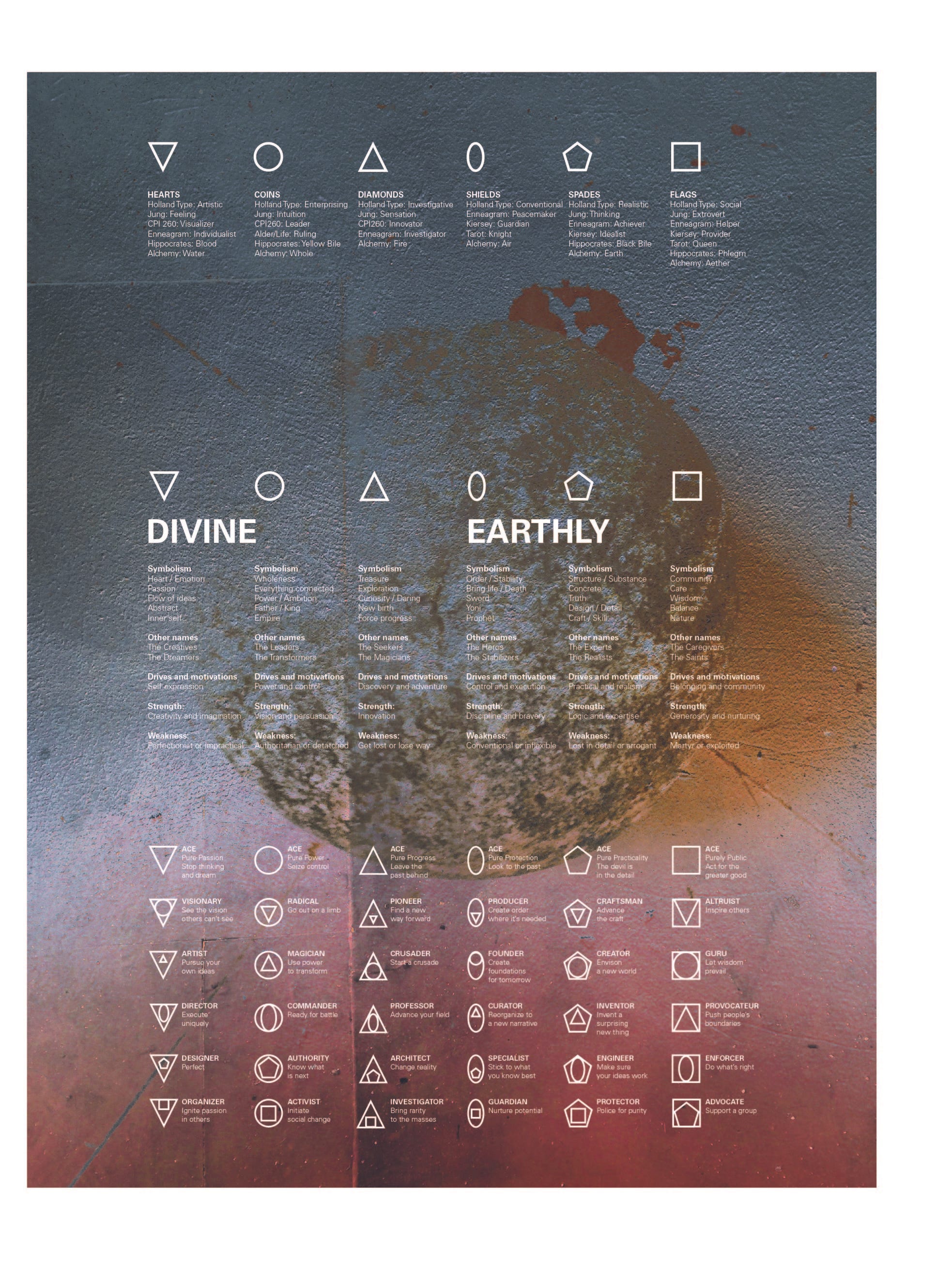
Layer 1: A convergence of global cosmologies and philosophies. The initial framework of the Nockwood Behavioral Archetypes. This not only defined the primary axis of ‘divine’ and ‘earthly’ that later became the ‘Monad’ and ‘Phronesis’, but it also identified a full spectrum of human behaviors —each suit paired with every other suit to create 36 behavioral actions.
Layer 2: A weaving in of divine forces—the Aeons. The next layer of complexity came by layering Valentinus’s aeonology over my behavioral framework. This was essentially the combination of two historic summaries —Valentinus summarized centuries of ancient writings about Aeons while my Behavioral Archetypes summarized modern behavioral psychology. The alignment between these two systems was profound which made it possible to entwine the two layers completely —all of the Archetypes and Valentinian Aeons are represented. A few additional characters needed to be added to make the system complete. This is where the 8 additional cards came from: Pneuma and Abraxas representing the divine inner and divine outer; Nebruel and Soter representing the core dynamic idea of damnation and redemption; Grigori and Epinoia representing inner vision and the communal faculty of being seen, watched over, kept honest by others; Demiurge and IEOU representing claimed authority and material judgment contrasted with divine justice.
Layer 3: Reversal became absence. One of the interesting aspects of the Aeons, is that they are all active forces —the energies and resonances that have a direct impact on us. The pairings in the syzygies (as described in Syzygies of Aeon) are complementary, not oppositional, but all are still active. This didn’t feel right to me. It left me with an unrealistic sense of over-stimulation— is there always something making you do something? I realized what I needed was a way to reference the absence of these forces rather than their presence. This is when I added a layer of meaning that was determined by the orientation of the card, during a reading. A reversed card in Tarot typically means the opposite of the ‘upright’ meaning. I decided that the reversed position of an Aeon card would not be oppositional but would instead mean the absence of the energetic force. Thus, the personal experience of an absence of strength is weakness; the experience of an absence of thinking is foolishness. An absence of remembering is forgetting. If Aeons are energetic, then it felt important that there was a low-energy state for each of them. After using the cards for several years, it became clear that this layer made for much more accurate readings and aligned better with real world experience — "There will be no savior," "You are not thinking," "Stop caring what other people think."
Layer 4: Jungian journey to individuation. The final layer built within the cards is that of modern psychotherapy. It builds upon the writing of Carl Jung that already had correspondences with ancient texts — he specifically references Gnostic Aeons in his book Aion. Psychoanalysis for Jung was a journey that took place over time— starting from an undifferentiated and unconsciously-ruled state, and ending with a fuller and deeper understanding of the self (or what he called your ‘true nature’). This journey is represented by the generational hierarchy I established for the Aeons —called the Dodecad of Matter and the Decad of Intelligences.
Jung describes a starting point of “one-sidedness” that needs to be corrected. Bythos and Mixis are the syzygy pair that address this rebalancing. The intelligence of immersion demonstrates how the one-sidedness of inner depth must be broken by an immersion and deep acquaintance with differences.
Jung’s idea of individuation focuses heavily on balancing suppressed dualities of personality. Anima and animus, conscious and unconscious, ego and shadow self etc. Jung describes how these dualities become destructive when a person refuses to recognise them. Ageratos and Henosis articulate an intelligence of intimacy that demonstrates how marriage and union can be achieved through intimacy, without elimination or dominance of either side.
Jung describes in The Development of Personality (1934) how living into your “true-nature” is the deepest form of self-determination. Such satisfaction will never be achieved by trying to please others and must come uniquely from within. Today we might call this ‘purpose’ or Crowley might call it True-Will. Either way, the intelligence of satisfaction pairs Autophyes and Hedone as a demonstration of the wisdom of living from a place of inner uniqueness rather than social performance.
What Jung called ‘the second stage of individuation’ is when the Self separates from the collective and creates a genuine individual standpoint. Acinetos and Syncrasis represent the turning point I called the intelligence of differentiation where a powerful and fixed inner authority starts to stand out against social pressure and collective demands.
The ultimate outcome of Jung’s process of individuation is a differentiated self —Imago Dei which he claimed was indistinguishable from a religious or spiritual encounter —enlightenment or Gnosis? This “God within” occurs when the psyche has overcome the divisions within itself. He warned that humans fail to recognize the Imago Dei because they tended to project this experience outward onto external figures, religions, or political leaders. This ultimate encounter with the whole self is captured in the partnership of Monogenes and Macaria which I described as the intelligence of being.
Layer 5: Shadow resonances. As a final layer of meaning, I created a series of ‘shadows’ that align all the cards and all of the suits against a single set of what I called ‘resonances’. These are not set properties but instead descriptions of dynamic relationships that span the whole deck and hold it together coherently. The dark and light areas of each card relate to a single angle from the ‘key-card’ below. The relational dynamics of the whole deck align to this relational system with each point of the star aligning to the six suits of the deck.
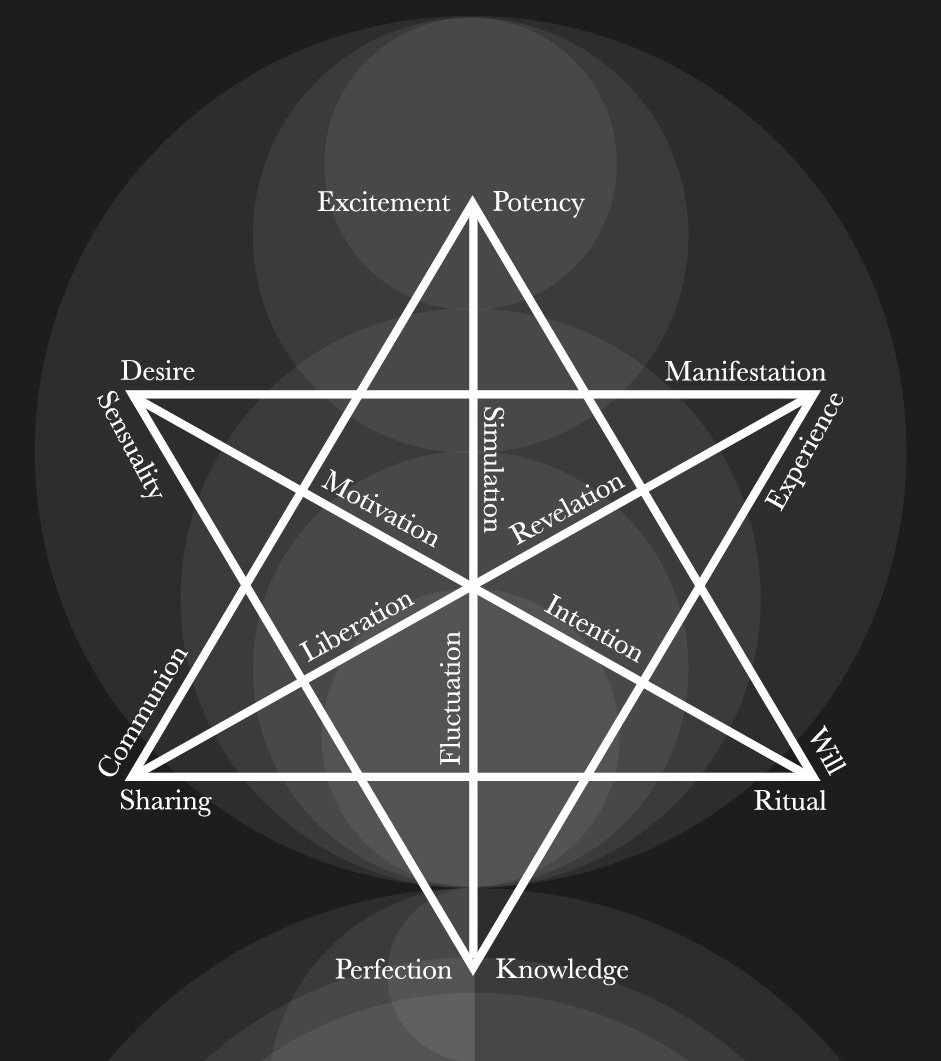
Aeon deck: five systems and infinite relationships
This is where the Aeon deck of cards truly differentiates itself from Tarot and other divination cards. Tarot follows a conventional, deterministic architecture: every card in the deck has a fixed pre-determined meaning. Each card exists independent of the other things around it —very Newtonian to have discrete objects, with defined properties that lead to predictable outcomes.
A tarot reading consists of placing each card in a spread and adding the pieces together to make a story. The answer you get is the same regardless of who is asking, when they asked and who else is in the room. The cards don’t know you are there and the conceit is that the guidance is coming from some external force and the reader is simply channeling that narrative.
Aeonology is something very different. An Aeon reading cannot begin until a person with a problem arrives — the cards are incomplete without that. It is built, not of individual meanings, but of layered systems. Each system describes not just an individual card but its relationship to all the other cards — the generations, the syzygy pairs, the suits, the pathway to enlightenment. The meaning of the cards only becomes specific when it is in a relationship to the other cards, in a particular moment, when the person and the question are known, when its orientation has been established, and only with the particular people present in the room.
I see this happen at every reading. Even though the first card in a spread is described as ‘defining the problem’, it rarely does. Most people have one or two major issues they want guidance on. They define the problem in their heads but the first card simply gives them a specific lens with which to think about the problem. The problem is never in the card, it’s in the relationship between the card and a new way to think about the problem.
The Aeon methodology allows for all of these relational, rather than deterministic, possibilities. Aeonology is designed to illuminate a relational universe, where meaning isn't stored in an object, but is instead generated by encounter.
What’s wrong with deterministic approaches?
Well, nothing. But, I feel relational dynamics are more honest to the experience of life than deterministic ones. Take for example all the personality tests and psychological typing tools —Myers-Briggs or “Which Disney Princess are you?”— that put you in a certain box of ENFJ or whatever. These labels, once ascribed to you, follow you around and subconsciously influence your thinking and behavior. If complementary, you reinforce that particular version of yourself and if negative, they might cause you to resist that specific categorization and do everything you can to avoid being labelled that way in the future.
I believe this way of thinking is false. I prefer to believe that we are a multitude of potentials. That we cannot be over simplified into any ‘type’ and any attempt to diminish us in this way denies certain parts of ourselves —whether we know it or not, conscious or unconscious.
A relational approach that I’ve tried to build into the Aeon cards, doesn’t ask “Which type are you?” and instead asks “What part of your infinite potential comes alive in this context or in this moment?” If we have an infinite and divine fullness (or potential) within us, then asking “What is our future?” or “What does the universe expect of us?” is an irrelevant question. Instead the Aeon cards ask us to expand our awareness to an infinite spectrum of potential and then learn to identify the resonances that come alive in a specific and particular context. The question the Aeon cards ask is “Where do you feel this combination of inner truth and exterior reality might lead?”
A relational view of the world allows for genuine change to happen. Rather than fixing you to a type, as fixed in nature, it helps you see yourself as a set of responses to a specific context. Change the context and you can change your being. More importantly, it trains your discernment. Learning to read the relations between cards, between self and others, between moments of past, present and future, is how we move away from pre-determined, manufactured and pre-programmed responses and move to genuine, uncompromising decisions. Aeon readings force discernment because they require you to investigate the moment from multiple perspectives, in a specific order, and asks you to reflect on your relationship to each.
Over time an Aeonology practitioner learns not to collapse decisions into simple, habitual modes of thinking and instead becomes expert at noticing the relational space between themselves and the cards. Between their inner authority and the external context. Every reading is a work-out for relational attention—inner knowing, an acquaintance with first hand experiences and the achievement of desired outcomes in a shared and relational world.