

This post is both an introduction for new readers and a test for myself: can I articulate how a series of seemingly disparate experiences and curiosities, spanning decades of work, reflection, and study, might cohere into something whole? Can the meandering paths of my professional and magickal life converge into a meaningful narrative? This is my attempt to find out (a long read!).
My Background
For several decades, I have dedicated my professional life to the manipulation of culture and mass psychology to achieve specific outcomes. To most people, human behavior is random, so complex that, especially for businesses, it is difficult to predict.
I discovered this while working as a qualitative researcher, conducting over 20 focus groups a week for seven or eight years. Most of my clients in those days oversimplified their customers, with segmentations, profiles, generational labels, and personas that kept their understanding on the near side of complexity. They were unwilling to accept the fact that they could never truly know their customers through the data that was easiest to measure and predict.
And yet, for me, the behaviors that were outside the norm, at the edge and least explained, were the ones that were the most interesting. These were the behaviors that most observers ignored because they did not fit their current beliefs. And yet, they are exactly the behaviors that are key to understanding what is really going on and, as a result, are likely to reveal new ways of seeing the world.
This is how I ended up as a strategist. Strategy talks a lot about insight, but the real value of quietly observing complex behaviors is to identify those weird features that data ignores and that normally remain unexplained, including paradoxes, anomalies, and oddities. Within such observations lie clues to new truths and competitive opportunities that the brands I worked for might be able to leverage or exploit. While my job title sounded like I had an MBA, I did not. My only real skill was untangling the complexities of human attitudes and behaviors.
My past work
At its most material, my professional work involved persuading people, for example, that a new variant of bottled water (Lifewtr) could quench a thirst for creativity; that a global bank (HSBC) could stand out in every market globally by demonstrating it appreciated human differences; or that the next big thing in business technology was not a more powerful box but more powerful connections (IBM e-business). For my first few decades as a Madman, the only tool we had to change people’s minds was mass media: TV, print, and occasionally radio. We used this powerful and magical force to shape popular culture throughout the 80s and 90s.
Later, around the 2000s, this changed when I realized that advertising’s interruptions would decline in importance as software was being shrunk down and incorporated into massive, distributed digital platforms and mobile phones. As the first Global Chief Strategy Officer of R/GA, I helped build, and feed people into, many of the platforms and apps that today dominate everyone’s lives. We developed strategies and introduced brands to all of the new digital platforms that were funded by advertising, including Google, Instagram, Twitter, Microsoft, Apple, and even Amazon and Walmart. We shifted many brands from digital advertisers to digital utilities that fit into people’s lives, all the while capturing their data. We believed it would make the world a better place, although I think we miscalculated the scale these platforms would achieve and the rapaciousness of human greed.
Finding good (and Gods)
After a while, I began to wonder whether my powers of persuasion were being squandered on purely material outcomes. I did not enjoy making fortunes for huge corporations with no consideration for the negative impacts on society. I did not enjoy the bait and switch that created user dependency with free services and then exploited these dependencies for unimaginable wealth for a few, already wealthy, founders and investors. It was time to use my skills for something more consequential.
Around the same time, I also started working with social innovators and social entrepreneurs, teaching some of my skills to the Global Fellows of Acumen and ultimately helping Acumen build its own narrative around new concepts such as impact investing, social innovation, and a new generation of social entrepreneurs. We believed these entrepreneurs would create businesses to solve problems of poverty and disrupt economic systems for positive social and environmental outcomes.
This world was funded by philanthropy and was very different from the commercial world. Businesses that served shareholders believed in only three Gods: the Gods of power, money, and fame. They gave lip service to other goals, such as the health and wellness of their employees, caring about customers, or some degree of social or environmental responsibility, although these beliefs were only there so as not to look too mercenary. The world of social innovation served entirely different Gods: the Gods of philanthropy who talked about empathy, generosity, and inclusion, although at the end of the day, they mostly served one thing, the ego of the philanthropist. A truth that is rarely spoken is that there is nothing more ego-boosting than playing God and having the audacity to believe that a single human with vast wealth can achieve things no other mortal could ever dream of. Some call it a savior complex; others call it the ultimate luxury purchase, eye-wateringly more expensive than any private jet or mega yacht. The biggest impact of philanthropy is neither social nor environmental. It is on the status of philanthropists among their peers. Consider how much we alter our perceptions of technocrats like Gates, Zuckerberg, Dell, Bezos, and Page because of their philanthropy. Less than 1 percent of their fortunes is actually being utilized, while the rest of their wealth sits unused in taxation-protected financial instruments.
Reductionist forces against humanity
These might seem like entirely different worlds, but I came to realize that the combined forces of technology, capitalism, and philanthropy were acting together to create the diminishment of humanity that we are experiencing today. United in both elitism and unmatched resources and influence, the technocrats, plutocrats, and philanthropists are comfortable with this reductionist vision for most of us. Indeed, their very existence depends on it. Technologists and plutocrats are pushing humans into the singular role of ‘consumer’, with little or no consideration for the widespread damage caused by such visions. Philanthropists, with the help of media, are pushing us toward idolatry.
On the one hand, humanity is suppressed and trivialized at scale by our digital overlords; on the other hand, the poor and the marginalized are devalued to mere pawns, used tactically to ensure the systems of financial inequality are not disrupted or altered.
What kills me is the role that I have played in evangelizing both of these dynamics. I failed to recognize the extent to which these systems undermined human dignity and (like everyone in these businesses) acted as if it was perfectly normal to use my fellow man as a means to the ends of the rich and the powerful.
While working as an advisor to Acumen for over a decade, and later as their CMO, I believed we were creating a counter-revolution to the corruption of fair market economies. I even helped capture the principles and practices of this work in a book titled “Manifesto for the Moral Revolution”. But I could not help wondering why none of our well-funded efforts, over half a billion dollars deployed, were able to achieve social and environmental change at scale. My conclusion today is that the ultra-wealthy who fund almost all of this pioneering work have no interest in changing the systems that enrich them. Philanthropic investment almost always boils down to making the donor feel less guilty about the inequality that they have perpetuated, while also making sure that governments, through increased taxation, do not change the rules so that the world stops working on their terms and in their favor. In addition, because of the PR and marketing spend surrounding these investments, the reputations of the philanthropists are enhanced and everyone else’s perceptions of their value to our society, and therefore our permission to allow them to take all the winnings from our global economies, are greatly improved.
Let me illustrate this with an example. Bill Gates (and I only choose him because he is one of the biggest philanthropic givers, although the same applies to all of them): If he really cares about racial inequality and believes he has a social responsibility to use his vast fortune to do something about it, he could afford to give every African American in America several million dollars. This would still leave him more than enough to live on and would undeniably make a difference to the lives of everyone who has faced systemic racial inequality. Instead we idolize his generosity for small philanthropic donations of one or two million to a few Black-owned social enterprises.
If anyone needs further evidence, consider how quickly the political change surrounding Donald Trump and MAGA has caused our technocrats, plutocrats, and philanthropists to back off DEI, Net Zero, and poverty-reducing initiatives in favor of investment in the President’s new ballroom or his library fund.
It feels like we’ve lost our belief in Humanity.
Because society’s most powerful forces of technocracy, capitalism, and philanthropy are all pushing in the same direction, we have lost our belief in our human capabilities. Instead of believing in the incredible potential of ourselves and the communities we live within, we are left with a fractionalized sense of who we are and what is possible. A metamorphosis was required. More than a metamorphosis, a deepening and expansion of how we think about the layers of complexity and the different dimensions of human being.
Do we even know the different dimensions of ourselves?
Professionally, I had done a lot of work on human behavior and even created a set of behavioral archetypes that I used to help brands dimensionalize their brands. To create this framework, I pulled from every attempt to categorize human behavior I could find, from the humors of Hippocrates and Plato, through alchemy, astrology, Enneagrams, Jung, Adler, Kiersey, Holland, the California Psychological Institute CPI 260, and even brain physiology. I even created a deck of cards which I called the NOCKWOOD cards because it was a partnership between William CharNOCK and designer Graham WOOD.
Although the NOCKWOOD cards worked well for brands, when I tried using them for people the language was wrong. It was too corporate and too grounded in the commercial realm. I needed to find better language. I looked at all the self-help and mindfulness literature but much of it was tired and corrupted, filled with words like purpose, journey, and renewal. Shoot me now.
An excavation not a creation
At some point in this adventure, I stumbled across some ancient texts that were written in the first century and then buried in the desert in Nag Hammadi, Egypt. These texts were discovered in 1945 and 1946 but not fully translated until a few decades ago.
By a remarkable coincidence, I happened to meet the woman who had translated many of them at Princeton, Elaine Pagels, who became an invaluable guide in my enquiry. To cut a long story short, some of these texts included early attempts to describe the origin of the universe and the important energies and forces that were fundamental to humanity and the universe we lived within. What was interesting about these cosmologies was that they were complex and layered rather than simple and obvious. They were also written in Coptic and ancient Greek, and although these languages are rarely used today, the origins of many words are still visible in the languages we use today. Examples include HEDONE, meaning pleasure; ECCLESIA, meaning gathering or church; and PATRICOS, meaning father.
From depth comes dimension—an antidote to emptiness
Interestingly, the very first emanations in these ancient cosmologies are not Aeons, but rather pre-conditions of creation. The first pre-condition described was BYTHOS which means depth, an infinite depth like that of the deepest ocean. Alongside BYTHOS was his female partner SIG which means silence. BYTHOS and SIG were both everything and nothing. They were both prerequisites: an infinite space for contemplation of something new and a living silence from which all voices can come. This is a lesson for all of us, that we must make space for anything new, and that we must understand the emptiness of what needs to be filled.
As I became more fascinated by these ancient stories of the essential nature of humanity and the energies that dimensionalize our existence, Elaine Pagels directed me to the works of Valentinus, a theologian from the 5th century who had developed a similar obsession. Valentinus had not only worked from the same ancient texts, but had described these energies and forces, which were called Aeons, into what he called an Aeonology, the study and development of these different dimensions of humanity and different aspects of being human. Valentinus believed that understanding these layers of humanity was life’s most important study, a lifelong journey of self-realization, not unlike Carl Jung’s process of individuation.
Spooky alignments
In hindsight, it is not surprising that my analyses of human behavior aligned so closely with Valentinus’s cosmology. Both were rooted in what Jung called the perennial wisdom, the deep patterns that recur through Gnosticism, alchemy, hermeticism, astrology, and tarot. These traditions, emerging across centuries and cultures, are blossoms from the same root system, periodic flowerings of the human search for meaning. The discovery at Nag Hammadi in 1945, like the Corpus Hermeticum centuries earlier, signaled another such blooming.
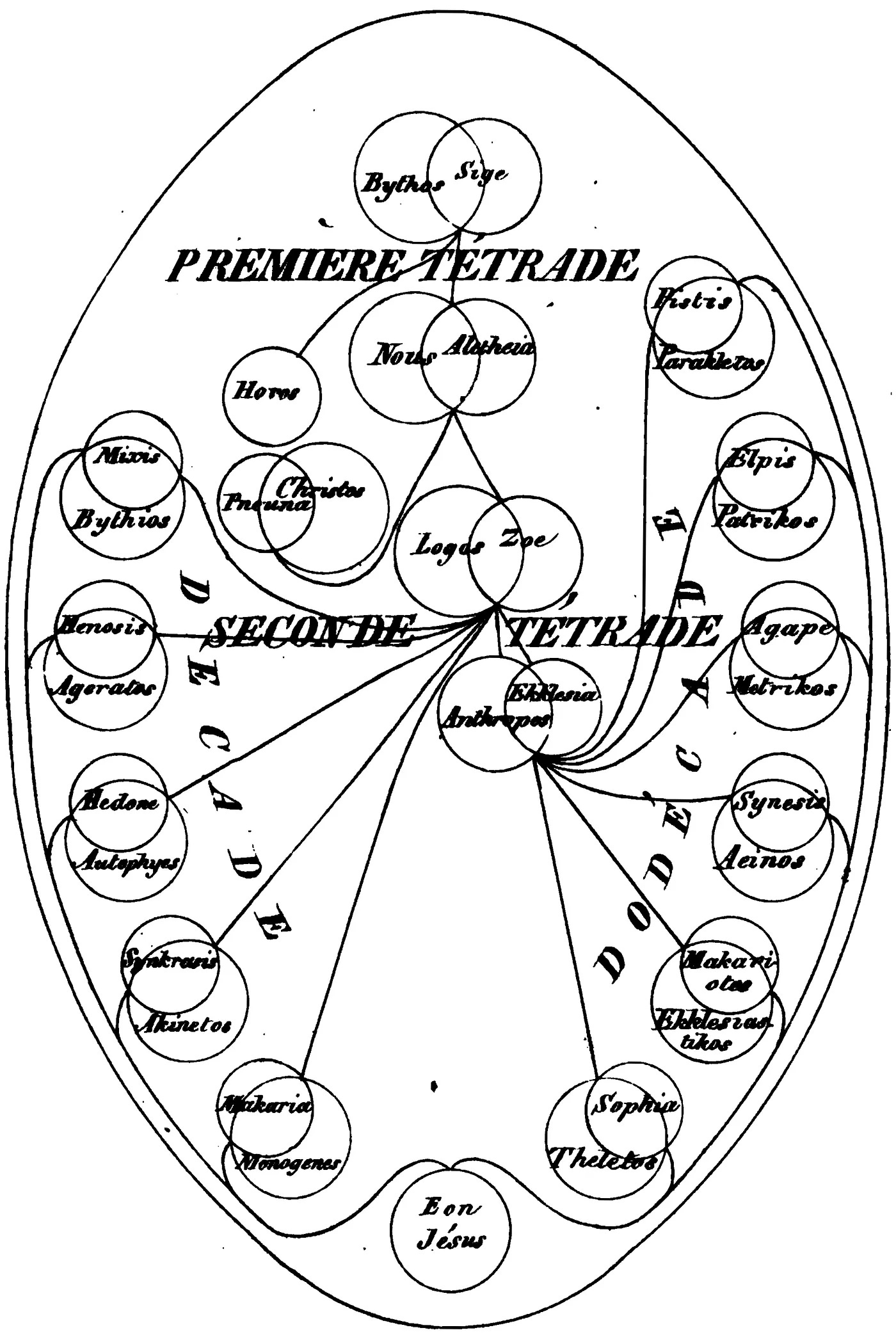
Image: The Aeonology of Valentinus. Full description of the alignments with AEON cards can be read here: LINK
An architecture for discovering our humanity
At the heart of Gnostic thought lies an acceptance of our incompleteness. However much we know, there are always infinite depths yet to be revealed. The first emanation in the Valentinian cosmology was the birth of a syzygy, a sacred pair: NOUS (Mind) and ALETHIA (Truth).
These two are inseparable. Like light and shadow, or order and chaos, each defines the other. With the emergence of NOUS came the capacity for thought, imagination, logic, and consciousness, the inner universe of awareness. But with this came ALETHIA, the longing to uncover what remains hidden, the desire to know the unknowable. The more we learn, the more we realize how little we understand. This is true both of our inner lives and of the cosmos itself.
Carl Jung, deeply influenced by these ideas, used tools like the Tarot not for prediction but as mirrors of the psyche, archetypal images that reflect the hidden architecture of our being. To engage them was to engage mystery, confront the shadow, and awaken to one’s depth.
Finding Humanity on the Far Side of Complexity
What Aeonology brings to the table, as many mystics and psychologists before it have also tried to do, is a recognition that humanity exists in the interval between knowledge and ignorance. However, the revelations of Jung, Gnosticism, and alchemy have remained locked within the academia of theology and psychology. What I attempted to do with the creation of the AEON Aeonology cards was to produce a practical tool that helps us explore these layers and depths and gives us a set of habitual practices that expands our understanding of their relationship to our present lives.
In the Valentinian view, existence unfolds through three intertwined layers:
The Physical (Hylic) which is the material realm of bodies, needs, and spatial dimensions.
The Psychological (Psychic) which is the realm of consciousness, story, and identity, including who we believe we are and what we imagine we might become.
The Spiritual (Pneumatic) which is the realm beyond comprehension, where faith, intuition, and love reside, the unseen forces that move us even when we cannot name them.
To be fully human is to live in the dialogue among these layers and to recognize that none can be reduced to the others.
A Reenchantment of Humanity
My hope in sharing the practice of Aeonology is to contribute to a renewal of faith in the human spirit, and to reawaken our capacity for awe, empathy, and wonder. We have been trained to trust systems more than ourselves, data more than intuition, and logic more than love. Yet what the world most needs now is not more control but more mystery; not more efficiency but more depth.
I see Aeonology not as a belief system but as a practice. A tool to be used to rediscover our many inner dimensions and in doing so unlock infinite outer connections with the world around us. I know it sounds complex but I invite you to see complexity not as a problem but as a solution — and to see our own incompleteness as a doorway to wholeness, so that we might participate fully in living.
If Aeonology can do this, it might just be the antidote to emptiness that will help us rediscover our own dimensionality. As if that isn’t enough, it might also raise an important question about the world I came from. What would happen if the systems that are diminishing humanity could be reprogrammed (hacked if you will) to work in the opposite direction? What would happen if the brands and businesses that depend on relationships with customers, suddenly saw past the illusion of simplicity sold to them by the platform owners and the media salesmen? What if they decided that rather than diminishing their customers into unidimensional ‘consumers’ that a better, long-term strategy might be to engage with people on a multitude of human dimensions? Instead of believing that marketing’s role is to compress humans into targets and transactions, maybe a better role for marketing would be to meet people in all their depth, contradiction, aspiration and complexity.
A renewed humanism in the world of advertising and marketing would insist that brands design for resonance. Instead of optimizing for the shortest path to conversion, they would cultivate the longest arc of trust and love. Innovation would no longer be defined by the next technological breakthrough, but by the next breakthrough in understanding what people truly need in order to grow, connect, and achieve wholeness.
Such a re-orientation would require us to have an equal belief in the potential of humanity as we do in technology and capital. It might inspire us not just to build better, faster, cheaper products but to expand our remit to the design of new products and services that acknowledge the material, psychological, and even spiritual needs of every customer. Such a future would create a new generation of businesses that serve communities, not just markets, and that imagine futures that are not just technologically possible but also humanly possible.
Interesting email from my technology chum following that last post. He asks if I’d also mapped Gnostic Aeonology to what’s going on with LLMs.
“Hylic → LLM raw data
Psychic → LLM internal model
Pneumatic → (missing), only simulated through meta-tools”
I have not but I am aware of a discussion about the limits of computational intelligence which seems stuck in the representational and responsive dimensions. Unable to get to a higher level of consciousness (ie awareness of its own awareness) that humans have. My old pal Nova Spivack has spent years exploring this. https://www.novaspivack.com/science/beyond-the-machine-what-if-consciousness-is-more-like-a-reflection
But this is an interesting question. Do LLMs illustrate the limitations of different layers of computational intelligence and consciousness? Can we map the achievements and failures of machine intelligence to the layers of a gnostic cosmos? Does artificial intelligence (or rather its failings) help us more accurately identify the characteristics of the highest order of human consciousness that gnostic texts call pneumatic? Is metaphysical consciousness the defining characteristic of human intelligence over computational intelligence?