
Growth in two directions
The suit of Flags tells us happiness does not begin within, but between.

In case you missed it:
The suit of Suns— Mapping the spiritual realm.
The suit of Spades— Digging out of material reality.
The suit of Hearts— How the mind makes sense.
The suit of Diamonds— Playing games with Truth.
The suit of Shields—The courage to be yourself
I’m getting to the final suit of the AEON cards. The suit of Flags. The suit of togetherness and interdependence. If the suit of Shields is ‘me,’ the suit of Flags is ‘we’.
Here in our material world, there are two distinct vessels we exist within. The first being the body, the individual identity, the Anthropos, and the second being the vessel of society, community and family.
The suit of Flags are represented by the color purple and the square —the shape of a home, a town square or even a flag that defines us by the company we keep.
I think I emphasized that our Anthropos is divided and the process of growth and development (Gnosis, to use the ancient term) is about finding unity. (In fact I over emphasized this in my last post —I wrote different part of it on different days and on re-reading it, I feel like I repeated this a little too much- sorry about that but at least you know it wasn’t AI written).
While it’s easy to think that these ancient texts advocate for some sort of soul searching and psychotherapy, the suit of Flags is here to tell us that many of the answers we are looking for can be found externally— in our context and our connections to everything alive around us.
Being together
There is so much written in psychology, philosophy and on motivational posters the world over, that insist that we are fundamentally social beings. There is no doubt that in terms of survival, human beings are weak and make great prey. However, by evolving for cooperation, by creating social bonds and relationships with others, we have not only survived, but been able to dominate the planet.
We live in family groups, we work collectively in teams and we identify through bonds and loyalty to tribes and gangs of many different varieties. Our communal selves are how we frame love, either as a partnership, a family, a tribe or a country. Our social vessel is our primary means of achieving anything, whether it be cooperating to maintain a household, cooperating to make a living or working together to overcome an obstacle. Our social selves allow us to define virtue and goodness as well as the corollary of evil and pain. These social groupings are defined by:
a mutually agreed set of rules that are sometimes strict, sometimes loose.
a sense of shared beliefs about who we are, why we are here and what differentiates us from others.
we signal our difference to others with identifiers and symbols that tell the world who we belong with—language, food, clothing, flags, badges, art, music, and architecture etc.
behaviors, rituals and rites (again, some formal and some casual) are also public displays of belonging and identity. Stories, myths and history.
These group activities, these bonds of shared identity, transcend each of the members of the group and outlive them. In fact, it might be said that it is the relational bonds with others that ensures our ultimate immortality—or at least our individual legacy with varying degrees of remembrance.
Reciprocity is our basic currency
The idea of reciprocity and the importance of it is imbedded deeply in almost all religious belief —Do unto others… One good turn…Give and receive…As you sow, so shall you reap… Quid Pro Quo.
But perhaps, more importantly, it is the engine behind powerful emotions such as gratitude and vengeance. We give thanks to those who help us and feel a loyalty to return the favor. Equally, if someone wrongs us or does not adhere to the rules of our group, or the primacy of reciprocity, we are strongly motivated to ‘get our own back’ on them. It is perhaps these two emotions that are responsible for, not only defining the groups we exist within, but also ensuring adherence to the group’s rules and conventions.
It might also be said that gossip and storytelling are important tools in maintaining a strong culture of reciprocity and cooperation. As Jonathan Haidt discusses in his book The Happiness Hypothesis, storytelling and gossip act both as “policeman and teacher.” He points out that before smartphones and the ubiquitousness of personal digital technology, gossip was one of the only mechanisms for keeping track of what everyone was doing and regulating the behavior of others. Social validation and social disapproval is one of the main mechanisms for members of a group to punish those who break their rules and reward those that conform. It’s funny to think of algorithms as a means of monetizing gossip and that social media is just a platform for profiting from gossip on a global scale…but that’s really what it is.
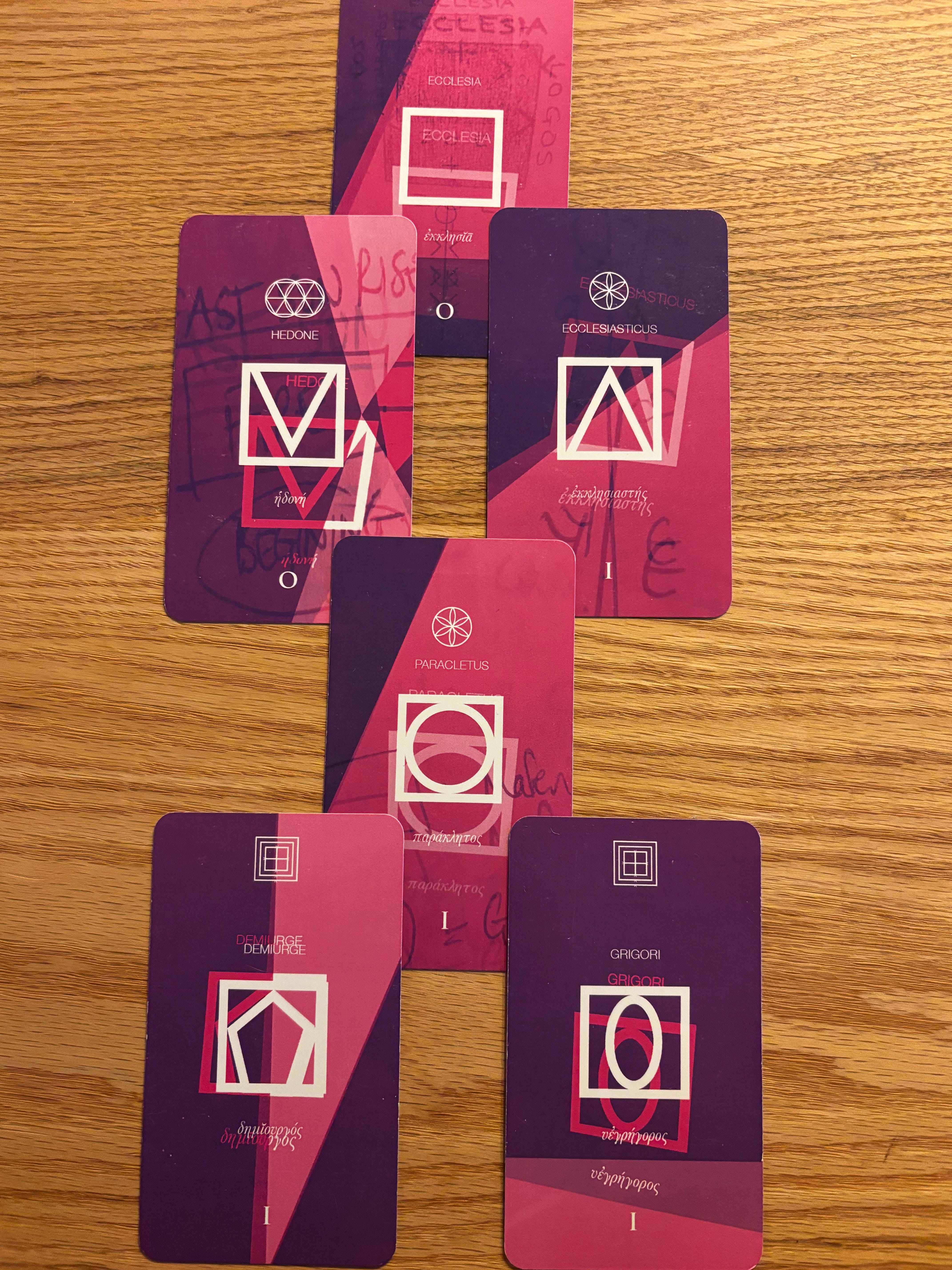
The cards of the suit of Flags
Ecclesia: Congregation or gathering. The ace of the suit of Flags is Ecclesia, which means ‘gathering’. This word is often translated as ‘Church’, and is used in English (the word Ecclesiastical) to define everything related to the church or the clergy. Once again, we find this is a corruption of the original intent. By making the church an “it”, a physical place with walls, rather than simply a ‘gathering’, the emerging religious institution of Christianity was able to formalize gatherings around one specific type of building and also achieve control over both the doctrine and the money.
But in the original sense, Ecclesia recognizes the importance of social bonds in our being. Our physiology too has evolved to reward cooperation and reciprocity. It is well documented how physical touch and social interactions are some of the most powerful drivers of feeling good. There are neurotransmitters in the Hypothalamus (among other places) that tell us unequivocally that real world connection is good for us. Our body rewards these connections (with other living beings) in exactly the same way as it rewards other life-dependent activities such as eating, drinking and sex.
Equally, the absence of social connection and social isolation is literally painful. If we feel distress, one of the first things we do is seek connection with someone. When we are alone, just existing feels more exhausting, dangerous and uncomfortable— much like being without food or water. That’s probably why we use phrases like “hungry for attention” or “thirsty for approval” to describe such moments. The absence feels equally urgent. There’s masses of data that shows how our physical health and wellbeing is directly related to how strong our social connections are. People with lots of strong social connections are healthier, live longer and claim to be happier.
So, the Ace, Ecclesia, is more than just the act of gathering. It is the inescapable, evolutionary necessity of social existence. It defines us, energises us and is our source of ultimate immortality. The whole suit relates to our community roles and our bonds with others.
Hedone: Pleasure. This card has the inner facing arrow alongside the square. It therefore recognizes the feelings associated with social engagement. As already mentioned, connection to over living things is a source of great pleasure and joy. Because the word sounds a bit like ‘hedonism’ it is often thought that this card is about self-indulgence and selfish pleasures, but that is the wrong interpretation. Hedone is the pleasure and joy that is shared with others. The Joy of connection, collaboration and celebration. For all the things we might make, create, build and produce there is no greater joy than sharing it. We might marvel at something of beauty, we might create something of beauty, but this momentary pleasure is greatly amplified when we share it with others. Creativity has little worth for its own sake but when it is offered to others, when it is passed on and appreciated, this is when the joy of creating becomes real. This is how stories work. How culture is created, how we collectively create context and meaning together. I might even go as far as saying that the vibrancy and energy of any social group— family, community, tribe or country— comes entirely from how well they fosters social pleasures over selfish goals.
Many writers over the years have dwelled on pleasure with similar conclusions. Nietzsche believed pleasure was a stimulant that allowed us to accomplish the most difficult things. Mihaly Csikszentmihalyi concludes that pleasure comes from immersing ourselves in activities. Joy as an outcome from pursuing excellence.
Perhaps one of my favorite modern writers in this arena is Michael Onfray who wrote a book called The Hedonists Manifesto. He talks a lot about being guided by maximizing joy and minimizing pain. The Aeon of Hedone is just that—a reminder that our body is a source of pleasure. Our body is a source of connection. Our number one source of happiness is sharing immediate, physical, sensory experiences without guilt or shame. So, get out, be with others, touch others, connect with others. Do something for someone else. Offer help or accept offers of help from those around you. Stop thinking about yourself and start thinking about how you might share beauty and joy with others. Hedone is the perfect tool to resolve the isolation and disconnection that so many feel (and maybe, just maybe, a return to Hedone might help us overcome our current mental health crisis).
Ecclesiasticus: Son of the Church. Having just told you about the corruption of the word Ecclesia to ‘church’, this translation of Ecclesiasticus might seem strange —but I didn’t think anyone would understand “son of the community." Ecclesiasticus gives the impression of a Pope or a Pontiff (or in Tarot the Hierophant) which is not far off. However, Ecclesiasticus, is not so much a high-ranking official and more a call to service or a servant leader.
The card Ecclesiasticus tells we must demonstrate virtue in our actions— A social leader who leads by example, living everyday as a demonstration of their values. Aristotle most famously defined each of us, not by how we think of ourselves, but by how we act repeatedly. He said “we are what we repeatedly do”.
In Eastern cultures this idea of service to the community is referred to as Ren. Respect of others and humility which is demonstrated through actions, through service and through respectful relationships with others.
The other important aspect of Ecclesiasticus is that we should always judge others by what they do, not what they say. Actions speak louder than words and there have been many times, when doing a reading, that this card comes up and I ask the subject to analyze what’s going on, not by the words spoken, but by the actions taken —it is always very illuminating.
There is something very timely about Ecclesiasticus in our age of modern individualism. So much of what this card stands for feels lost or old-fashioned. Aristotle’s ‘virtue’… "respecting others,” … dedicating yourself to service. Why does this feel so Conservative? Why doesn’t it feel fun or cool?
I think we need a reset on this, and possibly create some new language. What this card is really talking about is proactive commitment to creating real world connection and pleasure— the joy of connecting with others. Building small, local communities of trust with the people, creatures, nature that are proximate to you. It means actively creating and then actively sharing these interests of yours with others. Sharing what we discover, sharing what we create, and learning from the dialogue about such beauty. Ecclesiasticus might be Aristotle’s idea of ‘virtue demonstrated’, but it is also a reminder that pleasure and happiness is really only achieved by ‘doing’ rather than ‘thinking’ or ‘saying’. Happiness is relational not material.
Which leads very nicely to the next card.
Paracletus: The helper. This card is the card of reciprocity. Empathy and compassion. Doing things for others. The practice of mutual care and responsibility.
In traditional Christian interpretations, Paracletus —the helper, is used to describe both the Holy Spirit and Jesus Christ. The literal translation, which I always like to go back to, is derived from the Greek ‘para’ which means ‘beside’ and the Greek word ‘kalo’ which means ‘to call’. To be called alongside and to provide aid, counsel or comfort.
Carl Jung, also talked about the Paraclete as a spirit within us (again representing the influence gnostic thought had on his overall psychological framework). In his writings the Paraclete was similarly an inner daemon that works to reconcile differences and guide the self to wholeness, unity and individuation.
Now of course the Aeonic interpretation sits somewhere between these two. While Jung’s interpretation is overtly psychological and the Church’s is overtly spiritual, this suit also has an extremely material side, which both of these interpretations seem to ignore. The Aeon of Paracletus is our inner guide, character, our inner truth. The spiritual ideal of a Holy Spirit that teaches us, aids prayer and guides us to a light that fills us with love and joy. This practical guide reconciles individual needs of the body with the collective needs of the universe we inhabit. It points us towards the greater good— for our community, to our environment and to nature.
My friend Stanley McChrystal, personifies this practical aspect of service to others, having lived a life of military service. In his book ‘On Character—Choices that define a life.’ he describes how our moral character is not inherited, nor automatic, but a muscle that is built through what we do —our daily choices, discipline and service of others. What’s interesting to me about Stan’s take on this is that he thinks of character, not just as an individual thing, but also as a collective thing —and this is where he aligns with the card Paracletus which sits in this suit of Flags. In his book he points out that small groups are best for creating character because they can define their own norms and commit to shared values. Small groups, in close physical proximity (not remote or online), naturally reinforce discipline because peer accountability promotes integrity, respect and fairness. High-trust, small groups are not only more resilient, but they are also more likely to be kind to each other —forgiving mistakes and being gracious towards error. This kindness fosters long term, deeper connection and ultimately loyalty. I feel this myself. For so much of my life, I aspired to recognition and status on bigger and bigger stages. From a small village in Cornwall, to London, to New York to Global campaigns for some of the world’s largest corporations and through Acumen to achieve social impact in some of the world’s most impoverished nations. And yet, I’ve come back to the idea that the most meaningful impacts and happinesses are right here in my community, with people I can physically engage with— doing good work, sharing beauty, sharing pleasure and learning to love more deeply along the way.
Grigori: The Watcher. The last two cards of the suit, as with all the previous suits, offer practical guidance to behaviors that aid progression. The card Grigori (The Watcher) encourages us to watch out in a practical way. In Greek the word literally means “those who are awake” and the Aeon has the power to help us see—to awaken us and guide us to enlightenment. Grigori sees everything we do, our actions, our behaviors, our rituals and our offerings. If we are not careful he also reveals when we are deceiving ourselves and being dishonest. Interestingly, Aeon Grigori, like humanity, has the potential to be both good and bad. The Book of Enoch describes these two sides of Grigori and how they "taught men to make swords, and knives, and shields, and breastplates, and made known to them the metals of the earth and the art of working them, and bracelets, and ornaments, and the use of antimony, and the beautifying of the eyelids, and all kinds of costly stones, and all colouring tinctures. And there arose much godlessness, and they committed fornication, and they were led astray, and became corrupt in all their ways.
Grigori is therefore the card of awakening and ‘watch-out’. To know what brings you pleasure. To know that any beauty can be created or discovered and in order to deepen that pleasure, to share it with others. But the watch-out of the Grigori card is that we must also be watchful of the social pressures, the biases and an aggrandizing of our own awakening that is also possible. The tightrope between enlightenment and self-delusion.
Demiurge: The maker. The final card in the deck is the Demiurge. This literally means a person who makes something, a public worker, someone who builds in the material world. I have already covered a fair amount about the Demiurge in previous posts. Specifically, the post about The hidden architecture of reality and Thinking about thinking where I likened the realm of AI as a Demiurgic, constructed reality.
The Demiurge card combines the truth that we can literally fashion our own reality alongside the danger that we can also trick ourselves into believing it.
We are our own Demiurge, who dumbs down our idea of reality. We hide the fears and realities that we cannot control; we insist on our own correctness and righteousness; we manipulate our understanding of all of this to fit our existing point of view. We are our own God, because our reality is ours to create. But equally, we must find the humility to realize that we can never be a God and to believe we are is a misplaced sense of our authority and power.
Jung describes this same dynamic in his book “The Seven Sermons to the Dead.”
In this book Jung concludes that prior to achieving individuation, the human soul is dominated by many blind and foolish projections. In Jung’s system this Demiurge-like energy is the “alienated human ego”— having once been whole, it pulls away from its origins to become a blind and foolish being, desperately trying to recreate what it once had. With every futile attempt to be a real God, the ego-demiurge foolishly creates more of his own foolish world.
This is why the Demiurge sits within the suit of Flags. The alienated human ego is the archetype that shows us the dangers of arrogance and misplaced authority. If anything, this is the ultimate importance of the suit of Flags— of shared pleasures, of beauty, of reciprocity, of collective character and humility. These cards of social interaction awaken our true nature but they also ensure we aren’t simultaneously being blinded by our ego.
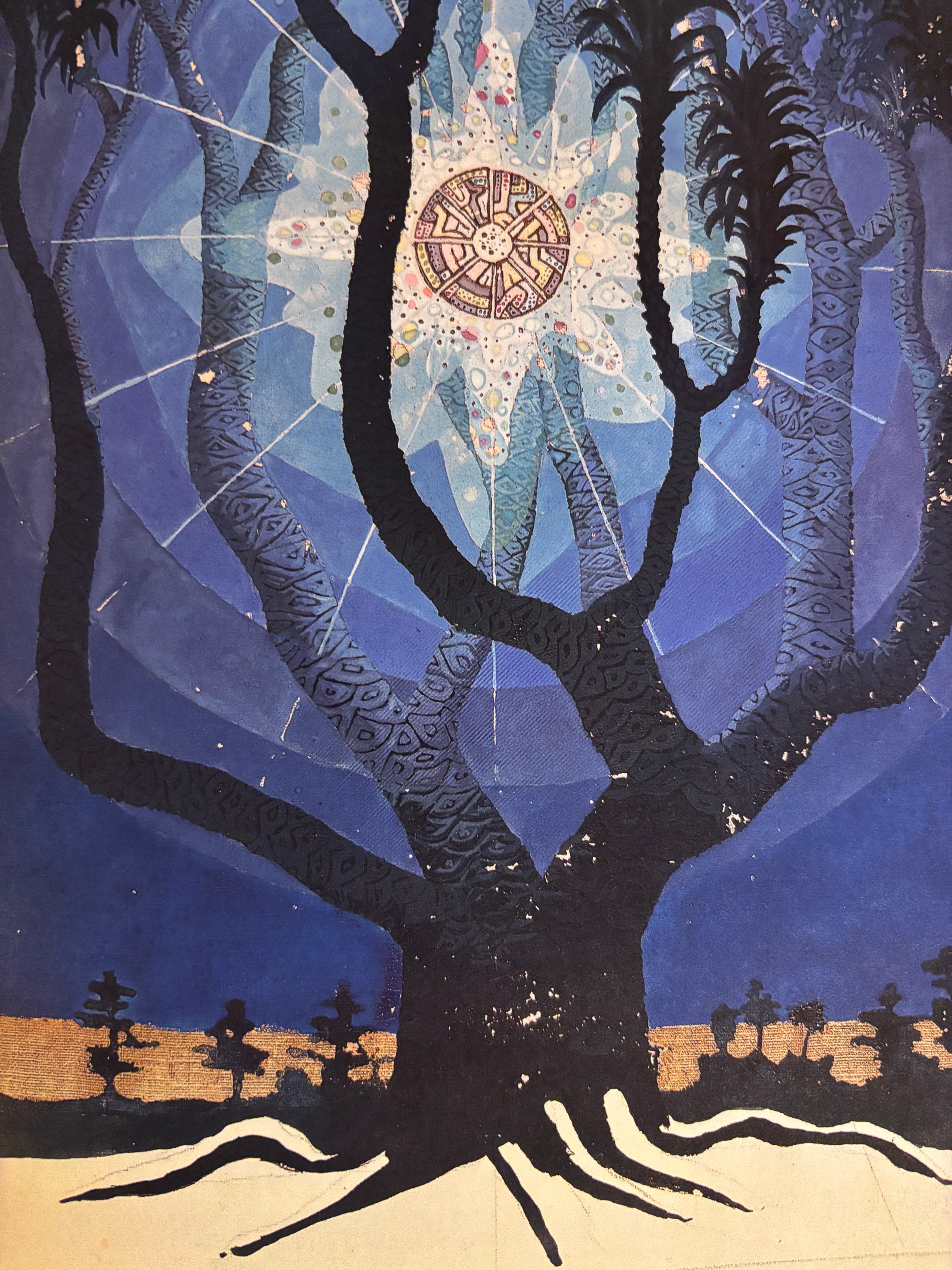
It is the important lesson that, like a tree, we must grow in two directions simultaneously. The obvious growth is outward: our externally facing, visible manifestation of who we are . An impressive core, a multitude of branches propogating leaves and seeds that gravitate towards the light. This is the external person and the internal self (The Anthropos). The less obvious area of growth happens below the ground, guided by darkness and nutrients, that spreading deep connections into our environment. These are our roots, our stability, our foundation, and they are essential to feed and nourish both directions of growth (Ecclesia).