
Thunder, perfect mind.
A poem, a prayer and the echo of a female voice silenced by men.

One of the first texts I started reading from the Nag Hammadi collection, of ancient scripts, was Thunder, Perfect Mind. I was fascinated by it. My first deck of cards (the behavioral archetypes) had been created by a process of pairing and this poem had a similar structure—a series of contradictory and opposing truths. This was also one of my first explorations into early Christian texts to find language that I could use for the cards in an attempt to evolve my work from the purely psychological to the spiritual and mystical.
I can’t remember how I first came across it, but for me it’s an incredibly important text in the development of the Aeon cards. When a new friend at a party asked me what I was reading, I answered “Thunder, Perfect Mind.” only to discover that I was talking with the pioneering theologian, Elaine Pagel, who analyzed it in her book The Gnostic Gospels—and ultimately struck up a wonderful friendship. My memory is that I first became aware of Thunder because of my neighbor Carolee Schneemann. She lived two doors away, down Springtown Road, and we both had old, stone houses that were once owned by the Deyo/ Dubois families. We also both shared a love of old texts and magick. Carolee had not been well and my friend Nicola Tyson (also an artist) went over to see Carolee for afternoon tea. I made a whole tray of English style sandwiches (which would be easy to eat) and we took some cheeses and some other nibbles too. In previous visits Carolee and I would often end up talking about ancient texts, it was something she have been interested in for years. Her bookshelves were filled with books with little strips of paper sticking out of them, each identifying fragments of text that she believed were passages written by women, even though the books themselves were almost always attributed to a man. I’m pretty sure, it was in one of these earlier conversations that I first came across Thunder.
Carolee and Elaine
But on this February afternoon, with Nicola, I learned that Carolee and my new friend Elaine had known each other back in the day. I had mentioned to Carolee that I’d bumped into Elaine Pagel and that she had helped me massively by pointing me in the direction of Valentinus’ cosmology for the cards. Carolee was excited because she said she had known Elaine in the 1980’s but had not seen here since then. Carolee had been a regular performer at the Judson Theater where a lot of her original work was presented. Elaine had also been in that east/west village of New York art scene. Carolee proclaimed that she had helped Elaine get pregnant with a magical fertility ritual.
Elaine Pagel describes this encounter in her book “Why Religion? A personal story.” Elaine had a friend called Mary Beth Edelson, who was also an artist, and when Mary Beth discovered that Elaine desperately wanted children, but hadn’t been able to conceive, she decided that a fertility ritual was required. Mary Beth gathered 4-5 friends and Carolee Schneemann was one of them.
The ritual involved all the requisite ritual items —sounds of ocean waves, candles, an enclosed space in the shape of a birth canal and the various participants spoke of giving birth. As Elaine articulates in her book:
“On a clear evening in February….I felt the ritual focus intensify. Suddenly a single question formed in my mind: “Are you willing to be a channel?” That jolted me into awareness of something that had never entered my consciousness: I was terrified of dying in childbirth. In the shock of that recognition, something changed, perhaps an involuntary release of muscles tensed with fear…
…another sentence formed itself [in my head], startling me, as if speaking to my intense desire to control what we can’t control: “You don’t have to do this: it does itself.”
Three weeks later, Elaine discovered she was pregnant.
February vibes
I told Carolee that she had to get back in contact with Elaine, and that I would connect them. Carolee was excited to see her again. Unfortunately, Carolee never got to meet Elaine again, but they did speak on the phone a couple of times after I connected them. They planned to meet but Carolee’s health declined.
The February afternoon, with Nicola, Carolee, Daniel and I was just before my birthday and Nicola was doing a show at the Dorsky museum (in New Paltz) the exact date of my birthday—February 23rd. Since we’d been discussing these ancient texts, Carolee said she wanted to read me a piece from the Baal cycle that she said was one of her ‘lost female voices’. She did. She turned up. She read the text for me on my birthday (February 23rd 2019) and sadly she died on March 6th 2019.
I keep a copy of the video of that reading. The quality is not great…but the memory is.
The text: Ugaritic Baal Cycle. Translation by Harris Lenowitz
The Virgin Anat Camouflages her divine aura and puts on the smell of goats and rabbits. She closes both the doors of the Palace of Anat.
She catches up to the troops in the mountain’s slit, in the valley between the cities.
How she slays them!
She cleaves the shore folk.
She smashes the western man. All around her.
Heads --a swarm of locusts.
Hands --like crickets, as many soldiers’ hands as thorns on cactus.
Anat bundles up her Prize. She loads up the heads on her back: She ties the hands on her belt, and, returning from the valley her knees slosh through the soldiers’ blood. The soldiers’ flesh up to her hips. She prods the captives with the back of her bow and Anat comes home unsatisfied with her slaughters in the valley.
She fights on, indoors.
She sets up. She smites them, then stands back.
Her liver full of laughter, her heart filled with joy.
Overjoyed for her knees wade in soldiers’ blood: soldiers’ flesh. Up to her hips.
When she has finished Fighting in the house, lunging between the tables,
she is full.
She rubs her hands in the soldiers’ blood.
She pours the rich oil into a basin and she washes her hands.
Virgin Anat washes her fingers —The sister-of-the -peoples washes her hands in the blood of the soldiers. Her fingers in the gore of the soldiers.
The chairs are only chairs again, the tables, tables, the footstools, footstools. She pours out water to wash in the dew of the heavens. In the oil of the land the rain from Cloudrider. The Heavens’ dew bathes her. The rain bathes her.
Back to Thunder, the Perfect Mind.
So Carolee, Elaine and I (…and the voices of women over the centuries) conspired to elevate this ancient poem. Elaine Pagel held Thunder, very closely to her heart. She told me it was written in the form of a prayer to the Ancient Egyptian Goddess Isis — A feminine divine tradition that was known to have female priests. But this is so much more than a poem by women for women because it articulates a divine truth that is true of all of us —that we are all contradictions. We have within us a diversity of perspective, many of which we suppress. We all have the potential to individual, spiritual revelation without the need for doctrine or religious authority.
Before the orthodoxy of religious structure, and theological suppression, almost all human spirituality recognized the divine masculine and feminine. Before our modern obsession with singular identities and rigid binaries, we had a clear understanding of our multiplicity. This poem reveals to all of us, not only the intense contradictions we all experience but also the false social and societal boundaries that humanity creates for itself. Thunder, Perfect Mind. is not a quiet, reflective poem, it describes a roar of these voices unheard. This sense is clearly articulated in the title—the word ‘bronte’, that is translated as “thunder”, literally means to roar, to cry out. Theletus and Nous (perfect and mind) describes the evolving, yet paradoxical and contradictory, human psychology (Nous).
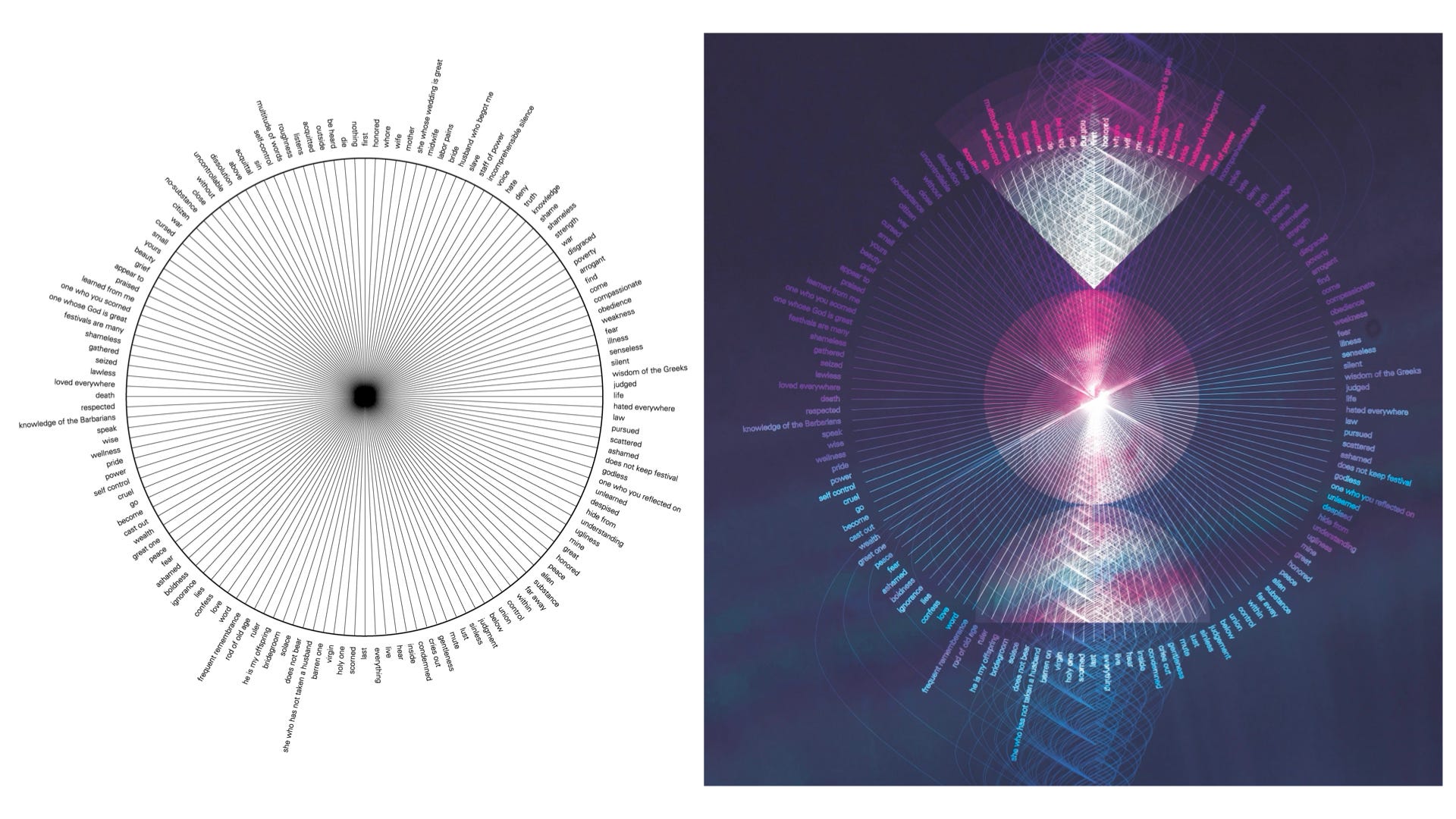
Creating the ‘Thundala’— Thunder-Mandala
You can find the text of Thunder, Perfect Mind here:
I started the mandala at 12 o’clock with a vertical line that represents the first of the ‘I ams’: “I am the first, and the last”
The final line of the ‘Thundala’ is positioned just a degree from vertical, to represent the last ‘I am’ of the poem: “I am everything, I am nothing.”
At 90 degrees, half way through, a horizontal line from the middle of the poem: “I am life, I am death.” Mirroring some of the Kabbalistic principles of life being on the right side (lightness) and death being on the left side(darkness).
From there on, all of the paradoxes of the poem, the “I’ams”, are in the exact order that they occur in the poem. They just happen to fall that way.
And yet so modern.
Thunder, Perfect Mind feels as relevant today as I suspect it did when it was written —it anticipates all of modern life and it’s contradictions. It encapsulates that multitude that is within all of us, if we dare to imagine that we are not the singular identities our ego and society insist we adopt. For all our strengths, we exude weakness. For all our outward projections of self, we are inwardly the opposite and afraid to explore those places because it would undermine our sense of who we are and collapse our ego. For all our posts on Facebook about happiness and togetherness, we are sad and lonely. For all our collecting of power and status giving identities, we are insignificant. Haters can love; Love shifts easiest to hate. Despite the incredible accumulation of human knowledge, we are still ignorant. For all our chastity, we are whores. For all our hanging on to moral integrity we are corrupt and dishonest with ourselves and others. Not just me, but everyone. We are all complex and paradoxical to the point where I think that if anyone claims to be any singular thing, then it is a lie.
(If anyone wonders why my social media profiles are “williamtheliar” it is a reference to Jean Cocteau who, in his writing: “Professional Secrets (1922)” claimed “I am a lie that always tells the truth.” which seemed appropriate to me at the birth of the social media age.)
We are not what we think we are. We are certainly not only what we present to others, no matter how honest and open we claim to be. More importantly, in the context of Thunder, everything we pride ourselves in being, we are also just as much it’s opposite. And this was where the poem really influenced me and the design of the cards. That the syzygies of the Aeon deck, and the writings of Valentinus back in the first century, is attempting to identify a number of the most important and inseparable forces and energies in the world. That motherhood (metricos), the giving of life is inseparable from Love (agape). That Utopia (Macariotes) is inseparable from being thankful for what you have and what is around you (Ecclesiasticus) — a very buddhist ideal. Those who claim knowledge are often the most ignorant. Those who display the most strength, riddled with fear. Those who protest a particular character are often hiding it’s exact opposite.
To quote Thunder, Perfect Mind:
Why, you who hate me, do you love me and hate those who love me?
You who deny me, confess me, and you who confess me, deny me.
You who tell the truth about me, lie about me, and you who have lied about me, tell the truth about me. You who know me, be ignorant of me, and those who have not known me, let them know me.
For I am knowledge and ignorance.
I am shame and boldness.
I am shameless; I am ashamed.
I am strength and I am fear.
I am war and peace.
Give heed to me.
I ended up writing a whole book, which has not yet been printed, but is available as a digitally printed eBook, that articulates these opposing energies and forces according to Valuentinus’s understanding. The book is available online at https://www.nockwoodcards.com/aeonology but if you want your own copy of the e-book you can get a downloadable ebook here:
I still think of Carolee and her project to expose hidden female voices. It’s now something I look out for whenever reading old texts. It’s rather surprising how easy they are to identify. I also try to recognize my own internal contradictions. For all my gayness, it’s amazing how straight I am. For all my pride, it’s amazing how deficient I am. For all my study and thoughtfulness, it is amazing how blundering I can be. For all my seeking, it’s amazing how blind I am.
This is why I thought the world needed the Thundala. A visual, rather than literary, manifestation of this important work. Something to reflect on. Something to remind us that we and the world are not as simple or as consistent as it first appears.